While I lived in Peru as a 16-year-old exchange student, I kept a fairly consistent blog. I am so glad I did because I can go back and feel the things that I felt in those times and remember the places I described. Without it, and all the photos I took, so much of what I experienced and felt is already lost, 4 years later.
I then studied for a semester at the University of the South Pacific in Suva, Fiji. I had originally started a blog but then before I even left for Fiji I decided not to keep one. I guess I thought it would be too difficult to keep up with or would be a distraction from my time there. That was an incorrect assumption (I had a painful amount of free time and no money to do anything) and it would have been nice to have written about my time there.
It's been a bit over a year since I returned from Fiji and I'm going to try to write a bit about some things I remember. I'll use my photos to jog my memory. Far too many things occurred within those near 5 months for me to write about entirely, which is unfortunate.
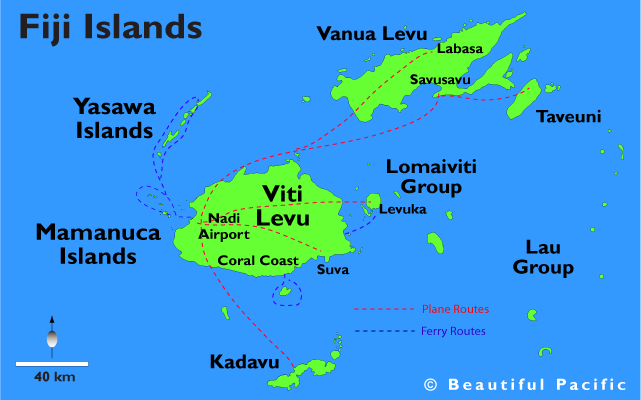
I recall that upon arriving in Fiji we spent a bit of time in Nadi (where the airport is located) and where one of our program coordinators lived. Nadi (Pronounced nan-di in Fijian) is on the other side of Viti Levu (Fiji's main island) from Suva. Viti Levu means Big Fiji in Fijian. Fiji's 2016 Olympic slogan was "Toso Viti Toso" which means "Go Fiji Go."
My first real meal in Fiji was fish and chips sold from a combination car wash/fish and chips stand. As strange as that sounds, my understanding is this place has the best fish and chips in Nadi. I'd never had fish and chips before, so me saying they were the best fish and chips I'd ever had doesn't mean much, but trust me when I say that they were incredible. Hot, greasy, melt-in-your-mouth fish with a nice batter, and soft, salty fries. This was the pre-vegetarian period in my life, of course.
We learned how strong the sun could be our first days there in Fiji. In Nadi, we rode horses around the base of the Sleeping Giant Mountains. I don't remember how long we initially stayed in Nadi.
In Suva, we got settled into our University accommodations. We had to get used to quite a walk when going anywhere on or off campus. It could be so exhausting, and I usually would arrive wet with sweat. Each floor/level of each dorm building housed, I believe, 7 individuals. Each had their own room (really decent actually--wardrobe, desk & shelves built into wall, mounted wall fan, good window). A kitchen and bathroom with 3 toilet stalls and 3 showers was shared among the floor members.
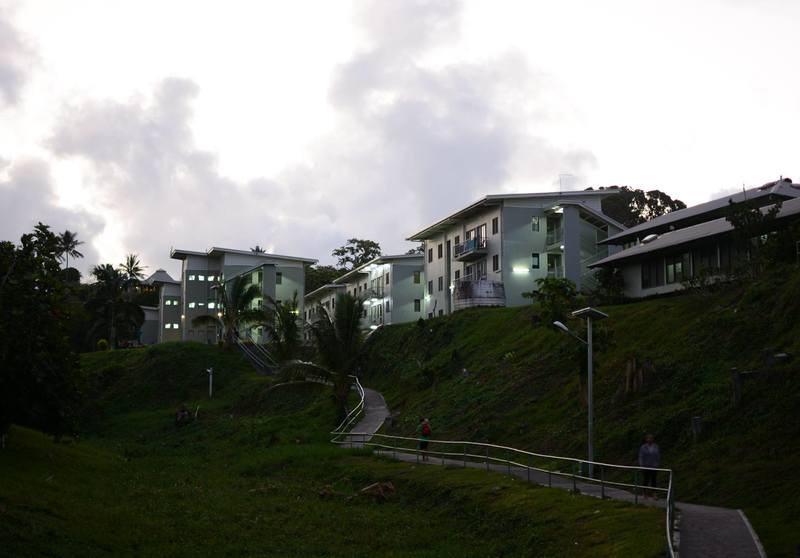
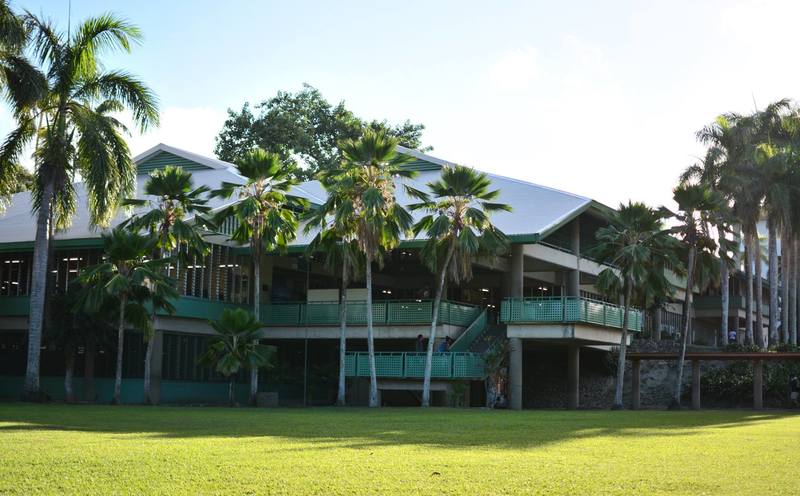
Above are the dorms at dusk. I took these photos. You can see the inclined path up towards the dorms. Below is the library of the University of the South Pacific. Note the vivid color of the flora.
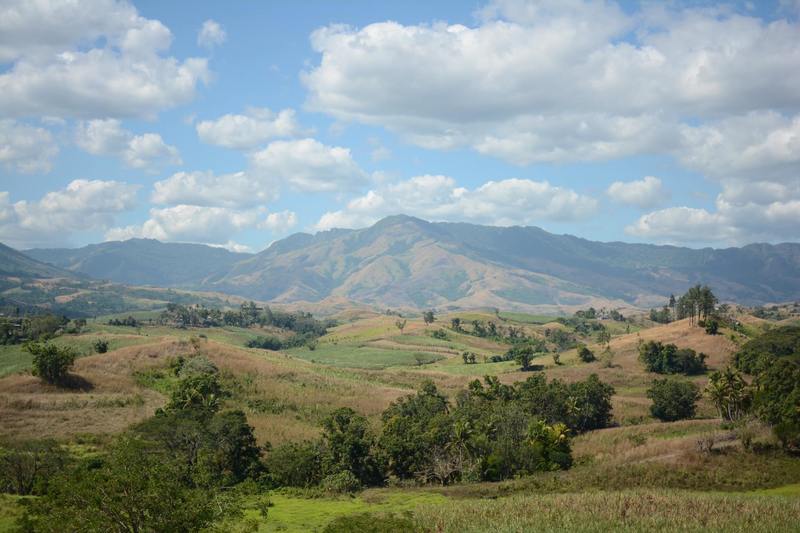
Looks like a green screen right? That was a real view that I stood in. Can't recall the name of this particular part of Viti Levu.
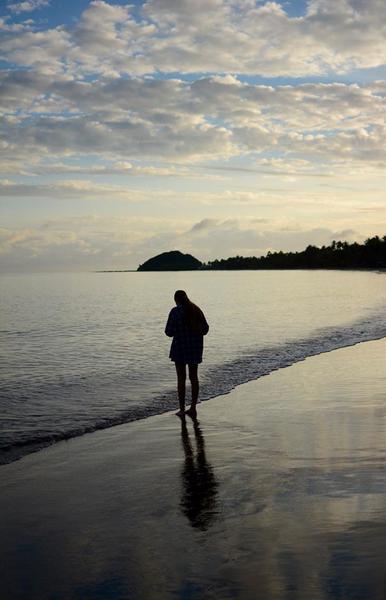
Below is me at dusk while staying at Pacific Harbour for a weekend. Got amazing photos during that evening. Had to take a bus from Suva to get anywhere. I met very few people that actually owned their own vehicles. At the end of the semester I met a kid originally from South Africa who was studying at the International School Suva and he had his own car which was really unusual for Fiji (and especially for a young person, a student I mean). I remember being shocked to realize that it was one of only two or three personally owned vehicles that I ever sat in during the entirety of my time in Fiji. We even went through the McDonald's drive-thru, which felt surreal.
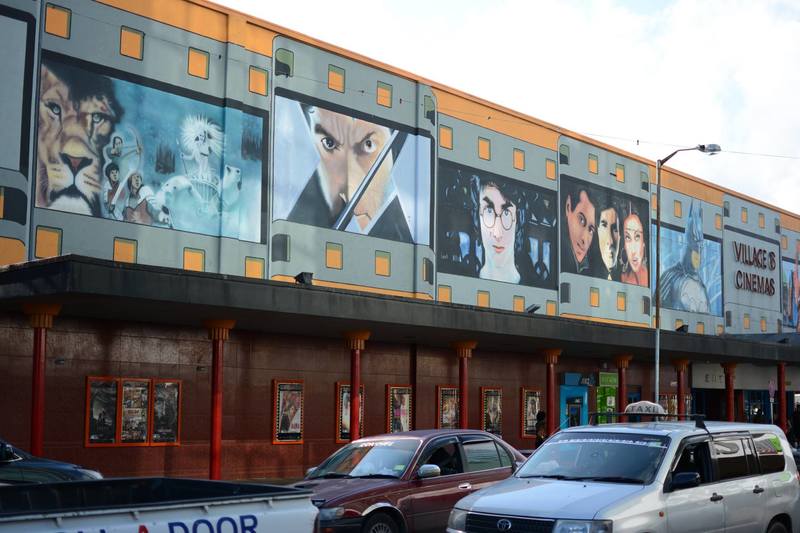
There are only 3 or 4 movie theaters in the entire country. Of course, most of them are on Viti Levu. I went to the movies often. Below is one of the theaters with its own really unique aesthetic.
At University, I took 3 courses (this seems like few, but 4 is actually the maximum that students can take). I chose them simply based on what I thought would be interesting, as at that time I was only attending a 2-year University in the United States and was only doing general coursework. I picked Developmental Psychology, Tourism in the South Pacific, and Political Ideologies. Tourism in the South Pacific ended up being my least favorite. Political Ideologies was by far my favorite. It was taught by a Swiss-born man who had lived in Fiji since childhood (Shout out to Professor Robert Nicole). That class was far smaller than my others so there was actual discussion among students and I actually felt like I was a part of that class. Professor Nicole also brought snacks each week for the class, what a guy! It was very interesting being the only American in a politics class, what with the United States' somewhat domineering position in the world. I learned that the United States conducted nuclear tests over the Marshall Islands and its surroundings waters, and that the nuclear fallout has had and continues to have devastating effects on Marshall Islanders. Imagine my shame at being the only American and only non-Pacific Islander in the room when that was brought up. And what was worse, was that I was the only one in the class who was unfamiliar with the topic (by unfamiliar, I mean that I had never even heard of this).
Read this article about it: http://www.washingtonpost.com/sf/national/2015/11/27/a-ground-zero-forgotten/?utm_term=.8f9dc61b8e64
Quote from the article: "From 1946 to 1958, the United States conducted 67 tests in the Marshall Islands. If their combined explosive power was parceled evenly over that 12-year period, it would equal 1.6 Hiroshima-size explosions per day."
So, I learned the most in Political Ideologies, by far. It was a hugely influential course for me and contributed really significantly to my Political Science studies. For this course, I was also able to visit parliament and sit in on a session. That turned out to be pretty comical because the Parliament members were arguing somewhat passive aggressively and from all the way across the room I think I saw a woman actually roll her eyes.
One of my great accomplishments from Fiji was the huge effort I made in studying for my final exams (mere days before my departure) and receiving all A's for my courses. Rather than re-write that experience, I will copy and paste my Facebook status from after my first final:
"Final exams in Fiji: you and 1000 other sweating students cram into an open-air sports arena, birds circling overhead (occasionally shitting on test-takers) encouraging you with their high-pitched shrieks, meanwhile it's a balmy 7,934°, you're painfully aware of the pools of sweat accumulating under your legs, and loss of consciousness seems entirely possible during your three hours of incessant writing."
Another major accomplishment was hiking the tallest mountain in Fiji.
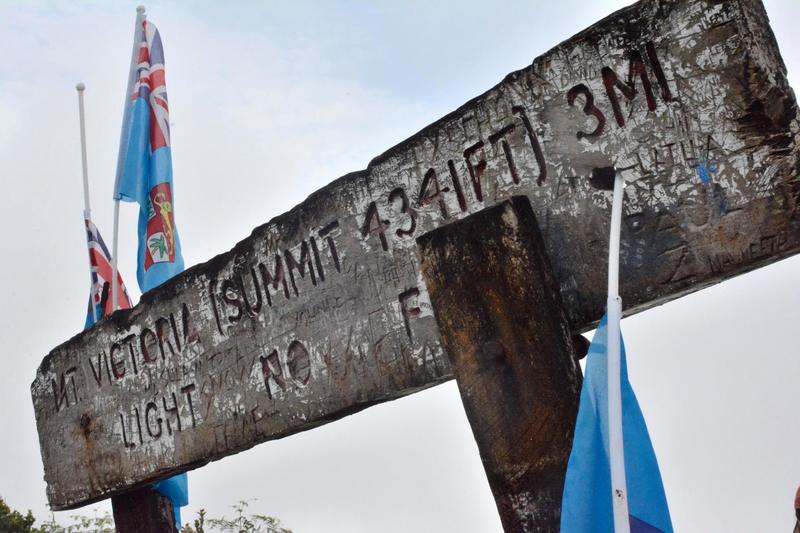
Above is the sign at the summit of Mount Tomanivi (Formerly, Mount Victoria from the British days). It's an extinct volcano that towers at over 4,300 feet. Our journey of climbing this mountain began at a village near the base of the mountain. The internet tells me the village's name is Navai, but for some reason that doesn't sound right to me. We stayed the night at that village in a bure (traditional Fijian hut). Inside the bure was quite warm, and we slept soundly. Outside the bure we were surrounded by green hills, mountains, and an exquisite night sky. An elderly man showed us a war hammer/axe thing that was used back in the days when cannibalism was still practiced. He told us a story of a reverend (a missionary) named Thomas Baker who, in the 1800's, was staying at the village. The story goes that, after having spent a fair amount of time staying at the village and learning Fijian customs, the Reverend made the fatal mistake of removing a comb from the Chief's hair. The head is the most sacred part of the body in Fijian culture, and we were told before visiting villages that it is more respectful to refrain from touching your own head and hair, and even more so to refrain from touching anyone else's head. The story, as I recall it, said that the Reverend Thomas Baker misunderstood and thought the Chief was offering the comb as a gift, and so he took it. This was seen as disrespect and the Reverend was cannibalized. Read about it here: http://www.telegraph.co.uk/news/worldnews/australiaandthepacific/fiji/1446723/Fijians-killed-and-ate-a-missionary-in-1867.-Yesterday-their-descendants-apologised.html
If I'm not mistaken (and you'd really think I'd be more certain on this detail, but the man telling us this story was slightly difficult to understand), the war hammer we were shown was the very one used to kill Thomas Baker in 1867.
We were guided up the mountain by two men from Navai. The journey began on flat ground as we made our way from the village to the base of Mount Tomanivi. I knew that I was in trouble when I was already tired before we had even began to ascend. While I struggled in my athletic wear and sneakers, the Fijian men ascended calmly with ease. One of them wore broken flip flops, I shit you not. As we ascended, it cooled and I could feel the moisture in the air. Much of the hike was at quite the angle, and required a careful ascent by pulling oneself up by branches and tree roots. It took us 3 hours to get up, and 3 hours to get down. I sincerely thought I might have to call it quits an hour in. But I forced myself to continue, truly had to force myself to get back up and move after a break, at the time hating every second of it as my body and lungs screamed at me. I was the slowest. One of the two guides had to stay behind with me at my slower pace while the other guide continued ahead with the rest. I didn't experience much emotion upon reaching the summit. I was so drained, exhausted and feeling antagonistic at having been roped into this (our program coordinator had chose this trip for us, a decision for which I am now extremely grateful for). There was nothing to see besides the surrounding mist, and the old wooden sign and a few small flags. The summit really didn't have a view at all. We were entirely surrounded by clouds. Had they not been there, I'm sure it would have looked incredible, but my understanding was that they are always there. Besides, I did it to be able to say that I climbed the tallest mountain in Fiji, not for the view.
The descent was no easier. It was even more slow-moving, if possible, and my legs trembled. It was a kind of euphoria to reach the bottom and to make our way close enough to the village to see the bures. Once it was over, I realized how incredible it had been. I didn't appreciate the hike at the time, but seeing the mountain from a distance (I mean once we left the village and had driven a ways out) made me really realize what a truly remarkable thing I had just done. After our day of climbing, I was seriously wet with sweat, as well as covered in dirt and grime. The shirt I wore that day had to be thrown away--it's light blue fabric never recovered, after multiple washings.
I am so proud to be able to say I reached the summit of the tallest mountain in all of Fiji. I genuinely didn't think I'd be able to make it.
That's one of many other amazing things I experience in Fiji. Writing this all now, I really regret not having kept a blog. Had I done so, I would have been able to write about these things with a fresher memory, more details, and more time to get it all down.
I also experienced hot springs and mud baths at dawn. That was so, so beautiful but I was unable to capture it effectively without a tripod. Not only was it breathtakingly beautiful, it was an overall really neat experience. The hot springs was like a big warm bathtub that one could swim around in. The air was cool and sharp in my lungs in the early morning. We went in the hot springs, retreated into the crisp morning air and then covered ourselves in cool mud from the ground. Then we went back in the hot springs and washed it all off. And all while watching the colors rise over the mountains. The colors began dark and inky with deep blues, then transitioned to lighter pastels with purples and oranges, then sharpened into bright, opaque colors of the day as the sun rose.
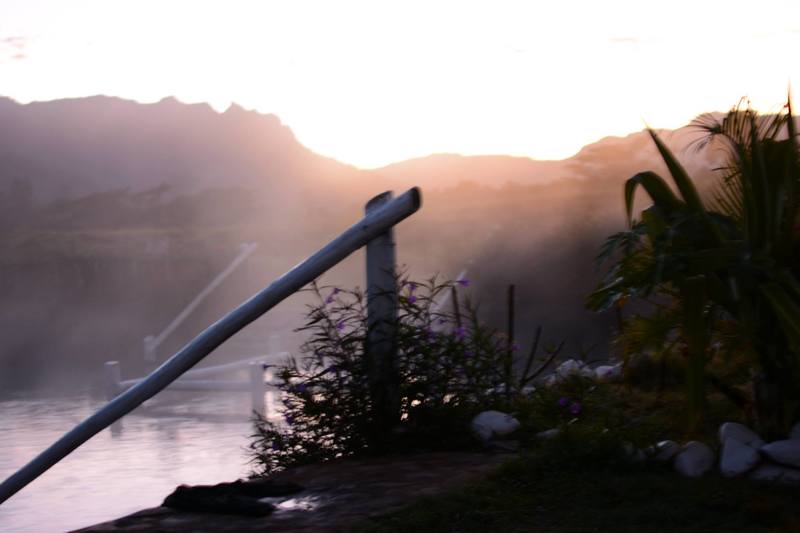
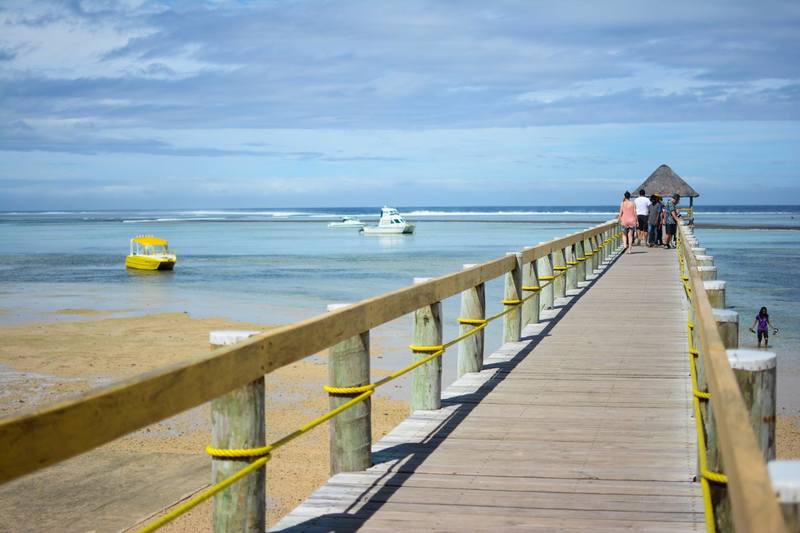
Above is from a quick stop at Maui Bay. It's a beautifully picturesque location on Viti Levu. A couple was having wedding photos taken at the very end of the pier.
I was also lucky enough to be living in Fiji at the time of the country's first Olympic medal win. At the Rio Olympics, the Fijian Rugby 7's team took home the country's first ever Olympic medal. Not only did they make the first Olympic win ever for Fiji, but they won gold. Because of a case of head-up-the-ass, I actually didn't see the match. I may have been one of the only people in all of Fiji to have not witnessed it, frankly. I caught the tail end of it, alerted by the sudden tremor of celebration that shook the country. School was canceled for the match. Jobs were canceled for the match. A national holiday was declared upon the Rugby 7's win. The country very nearly changed it's flag as a result of the match. A massive parade occurred to welcome the players back to Fiji. It was monumental. I can't convey how big of a deal this was to the country. This country has only been independent since 1970. In other words, this country has only existed on its own for 47 years. Before that, it was controlled by the British. So for such a young country to make its mark at the Rio Olympics and take home the highest honor for the sport of Rugby 7's is something unbelievable. Part of these players training regimen included running up and down sand dunes at Sigatoka. And I mean, look at these guys. Look at their legs, for gods sake.
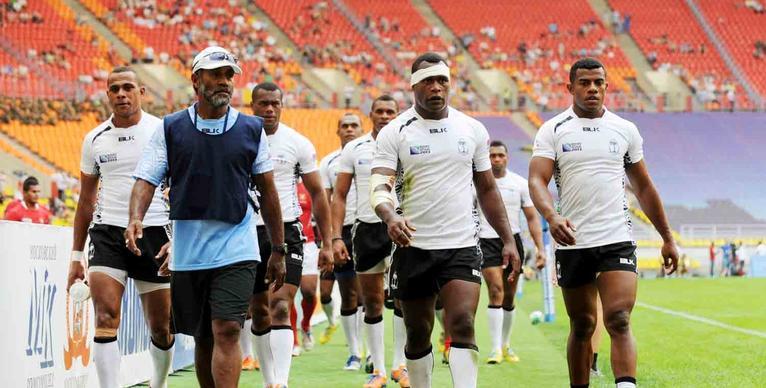
This team is the pride of all of Fiji. They are literally considered heroes.
In Fiji, I also spent several days doing a stay at a village. This was really interesting and also quite difficult. I believe we spent three days and two nights there. No electricity, no hot water. We spent the day walking around and playing with the children in the village, mostly. They held our hands and eagerly took us around the village. I stayed with a family in a home made of concrete blocks. In traditional Fijian culture (as is still present in villages), there are many customs that one must adhere to in order to be respectful. Women are not to show much of their legs, so we wore sulus wrapped around our waists. As I mentioned earlier, you should not touch your head or hair (especially in front of men), or touch anyone else's head. Most people in the village wear only flip flops if any footwear at all, and these are left outside the door. One must not step with shoes on the woven mat that is used for meals (the name of which is long gone from my brain). At the village, I slept in a bed surrounded by a mosquito net, and each morning I would wake up with large beetles clinging to the outside of the net, which horrified me. I struggled immensely with traditional Fijian cuisine and made a bit of a blunder when it came to consuming the dinner that was prepared for me. I took very small portions (doing my best to eat everything and not be rude) but took quite a long time doing so. It turned out that the entire family was waiting for me to finish, as this was customary. But I had no idea that this was the case, and if memory serves, I took upwards of an hour to get through my dinner. I felt horrible afterwards when I realized I had kept everyone waiting so long, but they expressed nothing negative towards me and showed only kindness for the entirety of my stay. All meals are eaten on the woven mat on the ground. These large mats are present in every single village bure. They are not just for meals, but for all times of gathering.
We participated in kava ceremonies, at this village and on other occasions during our time in Fiji. Kava is a traditional drink made from the powdered root of a pepper plant, and the internet describes it as "mildly narcotic". The powder is wrapped in fabric and then the whole bunch of fabric is soaked in a big bowl of water to make the kava. I hope it is not offensive of me to say it is basically mouth-numbing dirt water. In the traditional ceremony, one person makes the kava and those participating in the ceremony sit in a semi-circle or something similar, and each person takes their turn drinking a portion of kava. I did not take the photo below (photo credit to the Traveling Dutchman) but I really felt my description needed a photo to better illustrate it.
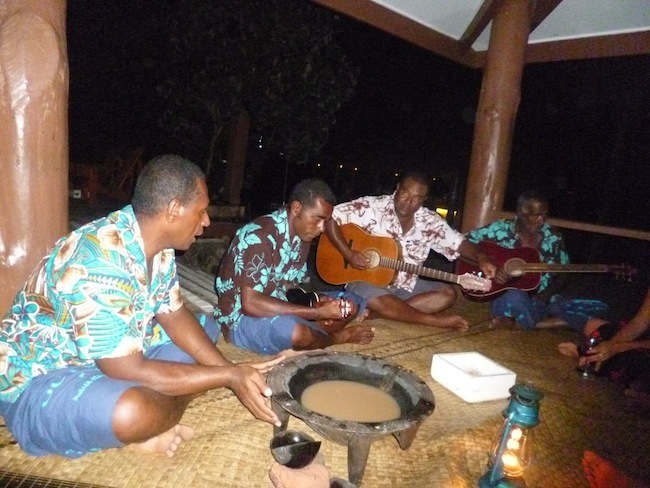
One claps before receiving the cup (usually a half-coconut used as a cup), downs it all in one go (or in my case, does their best to do so and not throw up and offend everyone present), then hands the cup back and claps again. Then it is the next person's turn. And that's how it goes. It just continues on like that, each person taking their turn. After a couple cups, one will notice a somewhat strange sensation in their mouth. It's kind of a tingling numbness that will spread a bit to your face and put you in a mellow, relaxed state. Kava is by no means a pleasant drink, but the kava ceremony is a really unique experience. It seems to be mostly the village men that participate in it. It's customary to bring the kava plant to the village as a gift.
In Fiji I also surfed for the first time. My first experience surfing was at Natadola Beach. I did not take the photo below, but this is where I experienced my first surf! It looked just like this too, the photo is not misleading.
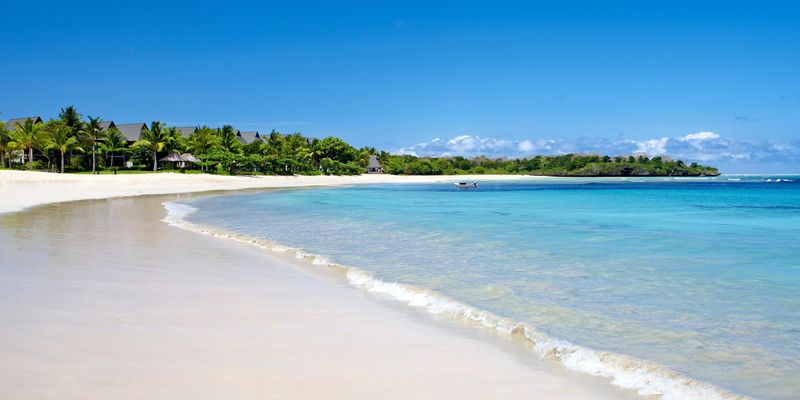
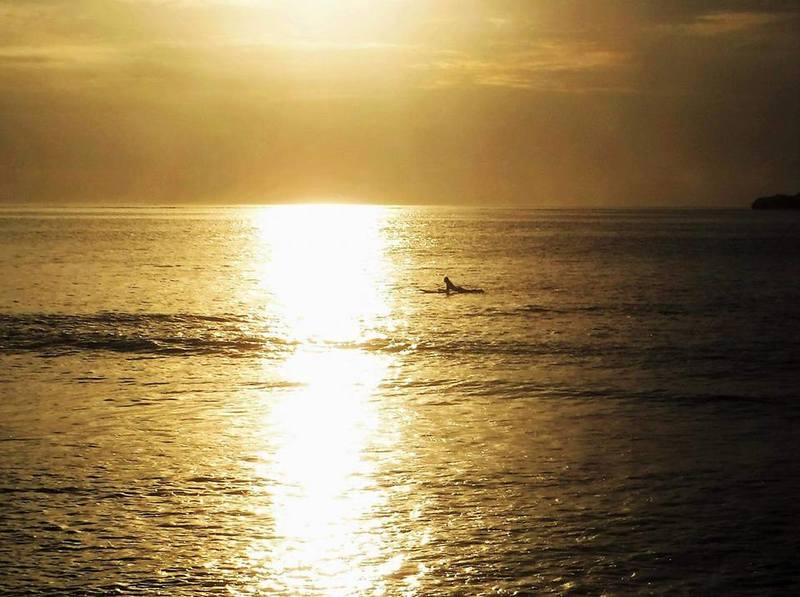
Of course the waves were tiny, just big enough to propel the board forward. My program coordinator brought boards for us to use. We used soft top boards (foam boards). I went down most of the time, and definitely flashed people at least once (I was not wearing appropriate surf swimwear) but I was so exhilarated by it and was so determined to stay out there and keep trying. I got up and rode maybe once or twice but eventually the waves died out entirely. My fellow study abroad-ers had given up long ago, retreating back to the sand. I don't think it was due to inability to get up, but more so that it just didn't interest them enough to stay out any longer. But I stayed out after everyone went back to the beach, and eventually I just stayed out not looking for waves anymore, because they had gone, but instead just existing on the ocean on a surfboard in the sunset. My friend Paige took this photo and I didn't even know she had taken it. I don't think she even quite realized that I was in it when she took it--I think her intention had been to capture the sunset and I happened to be there. But I sometimes can't believe that's me in that photo. I am just somebody from Wisconsin, and there I found myself, drenched in warm light from the sunset, wet but entirely comfortable and totally at ease. It was a feeling I have never before experienced, and not since experienced. The warmth of it all--the colors, the water, and light--it was all synchronized and resulted in this incredible sense of calm. I could have stayed there for hours. But it was approaching evening and I was waved in from the shore.
I surfed once more in Fiji, but it was a different experience from my surf at Natadola. The second time around, I was brought out to a surf spot called The Lighthouse (although there was no lighthouse as far as I could see). It was a surf spot out on the reef a ways off shore, which we accessed by a little motored boat that was then anchored in place. This was very clearly a higher level of surfing. Many surfers were already there when we arrived in the morning. The waves were daunting. They were monsters on steroids compared to the little 1 foot ripples I'd experienced at Natadola. These waves were well, well overhead. I was so eager to surf again that it did not occur to me whether or not I should surf here. Realistically, I shouldn't have. But like I said, I was so desperate to get another chance to surf, and I was with two experienced surfers who were helping us. My redeeming moment from this surf was riding a wave for maybe 6 seconds (it's really hard to gauge, it wasn't a clean ride and I was getting waterboarded through most of it). The surfer I was with commended me. This surf experience was exhilarating but mostly nerve-wracking. My heart rate must have been in a danger zone for most of this surf. The hardest part wasn't standing up. The hardest part was the recovery after inevitably going down. The waves were so powerful and came in such quick succession that by the time I forced my way back to the surface, the next wave was about to pummel me before I could paddle out of the way. And because the waves were so big, even if I made it on my board in time, I couldn't paddle away quick enough. So I just had to keep bailing and trying to go under so I wouldn't be hit with the brunt of the wave's power. If memory serves, I was out there for upwards of an hour and only had maybe 3 attempts at catching a wave (attempts, mind you). In other words, it took me over 20 minutes each time to get back on my board, out of the way so as not to be flipped and crushed by the wave, and back in position. It was so, so difficult. My arms tired out so quickly. Surfing is tough work. But I was so thrilled by it and am really eager to have another opportunity to surf.
So those were some of the bigger adventures. And there are more, but I've now been writing for hours and it's getting late. And the vast majority of my time in Fiji was not spent doing incredible things like climbing mountains and surfing coral reefs. Most of my time was spent on campus, in the immediate area around campus, and I spent an obscene amount of time on Netflix, I will admit. It was really difficult being a student of very limited means (that's sophisticated speak for 'poor') in a tropical destination because most of the activities that are associated with this location are ones that require significant financial backing. I couldn't exactly go island hopping with $100. So I found myself with a lot of free time and not much to do about it. And at the time I remember being so resentful of that, and being bored. I wish I could have just been better able to appreciate the time I had and done the best I could with it.
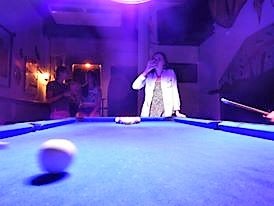
A lot of my time was spent at bars and clubs around Suva. Besides going to the movie theater and going out to eat, this is about the last option for entertaining oneself. I was 19 at the time, and due to not being of legal age in the United States, had never before experienced the bar/club scene. I really enjoyed playing pool at Traps. Traps was the downtown bar that we most often frequented. The above photo is me on Halloween (I was not in costume) at Traps. It was also at Traps that my group recognized Shay Mitchell, a famous actress from the TV show Pretty Little Liars. It turned out that she was vacationing in Fiji and she was at the bar that night with several men. My friend Paige got a photo with her, but I would have felt weird and annoying to bother her so I just looked on. Pretty crazy coincidence to run into someone so famous at such a small bar in little Suva.
Although playing pool was my favorite, we also spent a lot of time drinking and dancing at a few clubs in Suva. There is this drink that was common there called Tribe. It's a sickly sweet, brightly colored alcoholic beverage one could perhaps compare to a Mike's hard lemonade, but somehow even sweeter. There are specific songs that I will sometimes still hear that take me straight back to those times in those clubs. Cheap Thrills by Sia is one of them. Don't You Need Somebody with Enrique Iglesias is another. After dancing, we would often end up at the McDonald's downtown, intoxicated and blissfully enjoying our nuggets and burgers. I ate way more McDonald's in Fiji than I ever did in the United States, and that shit sticks around the middle more persistently than normal food. When not dancing or playing pool, time was spent in the booths of Traps playing drinking games.
While I don't think I would ever choose to live in Fiji again for a long period like I did, and probably wouldn't make an effort to return any time soon just because it's so damn far and so expensive to get there, there are some things about Fijian living and my time abroad that I miss being home in my small town in Wisconsin.
- Going barefoot. It is so common in Fiji to spend most of the day barefoot, especially in the villages but also in cities. I've seen people barefoot at the grocery store, at university, and I loved how common it is to be barefoot because it's a really liberating feeling and you feel more connected to the Earth and to nature, as granola as that sounds.
- Wearing a sulu. It was often so hot in Fiji that I would just walk around our dorm in my underwear with a sulu wrapped around me. Sulus are traditional in Fijian culture and my sulu (now quite tattered, but very soft from wear) has served me well. They can function as clothing, a blanket, a towel, a pillow, a sack with which to carry one's belongings, etc.
- Beaches and surf. This is something that just isn't available to me where I live. One can surf on the Great Lakes but only seasonally and it requires extensive wetsuit gear that really only a dedicated surfer can justify buying. So I miss being able to go to pristine, world-renowned beaches with suitable surf.
- Drinking age of 18. I'm not a big drinker by any means, but I enjoyed the nightlife and the ability to just go to a bar and casually hang out. It bothers me that I can't go out and play pool at the bar in the evenings here or casually drink and play games with friends in a booth.
There's so much more to my time in Fiji but I've got to wrap it up. Every experience I've had has shaped me. I spent too much time in Fiji not appreciating what was all around me and focusing on what the country lacked and the limitations I had. I still struggle with that where I am now and I think I always will. Writing it all down helps because it forces me to realize how lucky I am to have experienced what I have.
Vinaka for the good times, Fiji.
-G
P.S. Fun fact: Bathroom in Fijian literally translates to "little house"

No comments:
Post a Comment